While it’s safe to say Jesus Christ didn’t visit Weston-super-Mare, what about anyone else thought an incarnation of God by followers of a religion?
How about that incarnation of God also being someone once given weapons and ammunition by the Nazis with which to fight a war?
Or to up the ante more so, the person not only being black, but in the same year—2020—as the much covered throwing of Edward Colston’s statue into Bristol Harbour, one of this individual got smashed to bits in a London park with hardly a mention in the press?
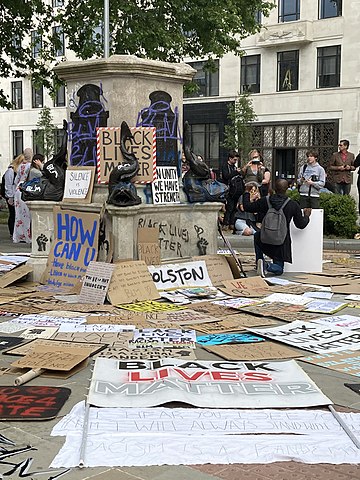 (image by Caitlin Hobbs, 2022: the pedestal on which Colston’s statue stood surrounded by placards of protest, many stating ‘Black Lives Matter’; image licensing here)
When first hearing of this from Viv Gallagher, it seemed there might be opportunity for a major scoop, the revealing of a long forgotten piece of historical fact; my conclusion based on nothing more than not hearing the story before, something potentially a bit narcissistic, but for previously asking locals for interesting stories.
The person in question has had a blue plaque erected in Weston, this happened September, 2019, when one was also erected in Bath on the same day; descendants and high ranking members of the religion attending an unveiling ceremony in Bath before getting on a train to Weston-super-Mare as the person in question used to, to travel to another unveiling there, mayors, various dignities and a few press present at both.
I chose Weston as the setting for The Medusa Protocol not simply due to living there, but instead how perfectly its quirks fitted the story to be told; the returning curse in particular (Welcome to Weston). An aspect of the story is the way people prefer fiction to actual truth, and given the intriguing aspects revealed above do make for a fascinating story, while it’s the likes of ninjas in the woods one is more likely to be told about, that point couldn’t be better made.
Maybe it would’ve got a direct mention if only for knowing about it when writing part one Wish You Were Her (chapter one). But that was before the blue plaque was up and seemingly nobody in Weston knew about this incarnation of God’s numerous visits there.
Icing on the cake, I went into Weston to grab some pics of the plaque only to get talking to a few passers-by who wondered what I was doing taking pictures of what appeared nothing but a wall, the plaque not being noticed. I ended up like a bit of a tourist guide telling an ever growing crowd about how an incarnation of God used to visit Weston-super-Mare and stand on the very spot; while in the process, someone walking by shouted out, ‘Jesus used to go for a pint in Uphill’.
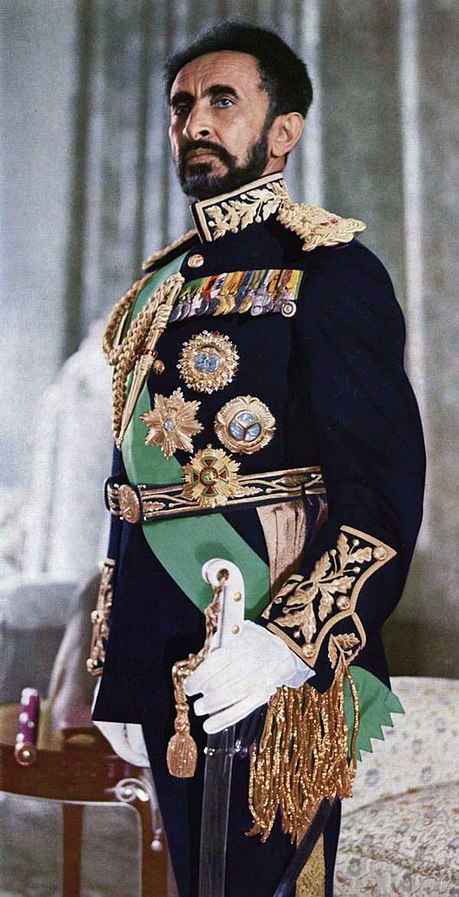 The incarnation of God who did visit Weston is Haile Selassie, Emperor of Ethiopia from 1930 to 1974 (image: Emperor Haile Selassie I in ‘full dress’; licensing information here).
The religion that believes him to be so: Rastafari.
Emperor Selassie was considered revolutionary for introducing social reforms, abolishing slavery and leading Ethiopia in the Second Italo-Ethiopian War; a pre WWII conflict starting 3rd October, 1935, and bearing details that highlight both Europe’s disarray before WWII and also the contempt with which it viewed Africa.
Without the courtesy of a Declaration of War, two hundred thousand Italian troops invaded from Eritrea, an Italian colony at the time; while simultaneously a smaller number attacked from ‘Italian Somalia’.
(image: map showing area of Africa containing Eritrea, Ethiopia and Somalia, plus surrounding countries and water/sea.)
Ethiopian resistance was strong, but no match for the modern weaponry of the Italians, and it was no less than Nazi Germany—soon to form the evil Axis with none other than Italy (plus Japan, Hungary, Romania, Bulgaria, Finland, the Slovak Rep, Croatia and Thailand)—that came to the African nation’s aid by sending weapons and ammunition.
Hitler’s motive: being annoyed with Mussolini for opposing his desire to integrate Austria.
This assistance slowed what the Italian’s thought would be a straightforward walkover to such a degree it drained resources enough to leave Italy more dependant on Germany economically, and thus Mussolini less resistant to Hitler’s plans for Austria.
Britain’s part in it all is dubious; some years prior on December 14th, 1925, it secretly signed an agreement with Italy recognising the fascist government’s right (over other European countries) to manipulative the region, in particular agreeing to the Italian idea of building a railway through Ethiopia to connect Somalia and Eritrea. When the agreement was leaked, it was considered by some to effectively be the betrayal of one member of the League of Nations by another.
 At the start of 1936, one year into the war, Time Magazine named Haile Selassie ‘Man of the Year’ for 1935, his speeches making him a hero for anti-fascists the world over. However, at the League of Nations, only six members refused to recognise Italy’s occupation: China, New Zealand, the Soviet Union, Spain, Mexico and the USA.
(image: Time front cover featuring Haile Selassie; licensing information here)
Selassie managed to escape Italian clutches, Britain, perhaps out of guilt, sending a naval warship to bring him back to the UK where he lived in exile from 1936 to 41.
He stayed at a couple of addresses for brief times, before settling at Fairfield House in Bath. The Emperor purchased the property, and in 1958, during a return to Bath to receive the freedom of the City, Haile donated it to the people of Bath to be used as a residence for the old-aged; a roll it fulfilled until 1993, when the room dimensions became too small for updated regulations.
(image: Fairfield House, Bath; licensing information here)
During his time living in Bath, Haile Selassie became partial to the Tropicana lido on Weston-super-Mare beach, regularly travelling down by train to use it (as the crow flies it’s a one way distance of approximately 27 miles).
In part, its Wikipedia page says: ‘the site was first developed as a 950 square metres (10,200 sq ft) swimming pool in 1937 and included an art deco diving board. At the time it had the highest diving board and was the largest open air swimming pool in Europe. When it was opened it was simply known as “The Pool”, becoming branded as Tropicana in 1983. The reinforced concrete diving board was demolished in 1982. As part of the rebranding, features such as slides, a wave machine were introduced. The Tropicana had enormous fruits as a feature and adopted the tag line, “It’s fun and fruity. It’s wet and wild”. It remained a popular attraction for many years.’
(image mine 2023: the main façade of the Tropicana, Weston-super-Mare)

The Tropicana is considered a landmark in its own right and is found described as recently undergoing regeneration after a period of neglect, even hosting the Banksy exhibition Dismaland in 2015 and more recently the highly criticised as a waste of public money See Monster. The plaque is placed on its front exterior to the right of the above image.
(image mine 2023 : the full length of the Tropicana front taken from a side angle with added arrows to show to exact location of the plaque)

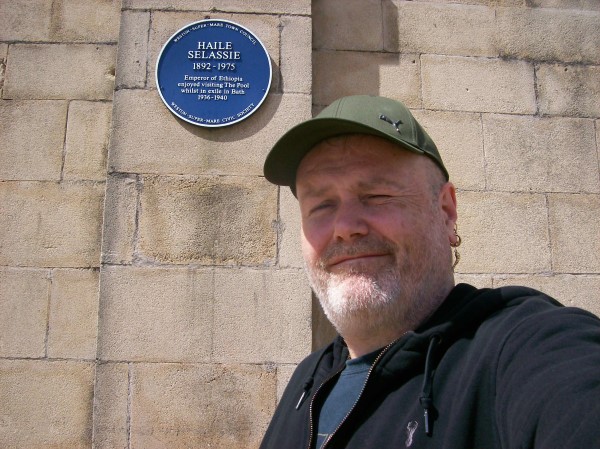
(image mine 2023: the blue plaque for Haile Selassie; inscription reads: Weston-super-Mare Town Council / Haile Selassie 1892 – 1975 Emperor of Ethiopia enjoyed visiting The Pool whilst in exile in Bath 1936 – 1940 / Weston-super-Mare Civic Society)

Selassie visited often and was always recognised when he did. In being so, the Emperor would be offered a fast track through to the changing rooms; something he always declined, preferring to remain in the queue where he was said to chat to those also waiting with charm, grace and enthusiasm.
(image mine 2023: me following in the steps of Haile Selassie)
The above mentioned regeneration—interior photos further below—might well conjure images of a modern facility with a swimming pool here and the ability to host the above events there.
Not in the slightest. Instead any sign of anything swimming pool has been filled with concrete to create what looks, when empty, like no more than a small car park. It’s certainly a lot better than letting it sit there and rot, but I can’t help but think how valuable the idea of the water being somehow Holy would’ve been to the local tourist industry.
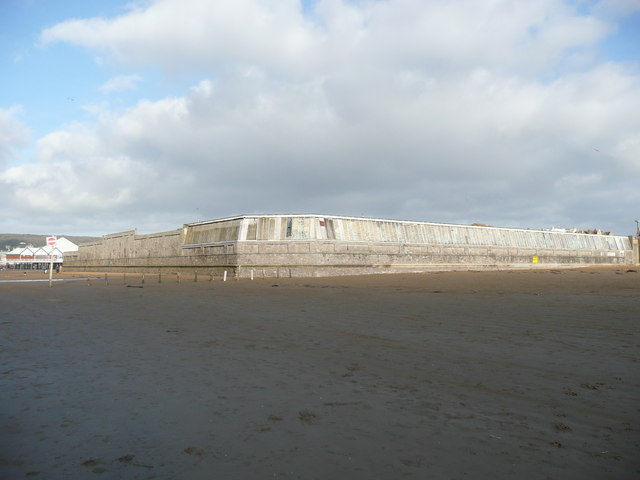
(image: a photo of the Tropicana taken from beach simply shows the high plain exterior wall that protects it from sea water; © 2008 Peter Barrington)
Rastafari started in 1930s Jamaica; the words of Haile Selassie initially striking an anti-colonial chord, before several protestant clergy—particularly the prominent Leonard Howell; a.k.a. the First Rasta—claimed Selassie’s becoming Emperor was the realisation of a Biblical prophecy: the second coming of Christ, according to their understanding of the nineteenth chapter in the Book of Revelation; thus meaning he is the messiah as prophesied in the Old Testament: God in human form.
(image: the Ethiopian flag from which the Rastafari colours of red, gold and green are taken)

 Jah, the Rastafari term for God, is an abbreviation of Jehovah; while the term ‘Rastafari/Rastafarian’ originates from ‘Ras Tafari Makonnen’ the title of Haile before he became Emperor: ‘Ras’ being Semitic Ethiopian for prince and ‘Tafari Makonnen’ being Selassie’s personal name.
(image: left to right: Tafari Belew, Tafari Makonnen, Beru the children’s care-taker, Imru Haile Selassie; circa 1900, licensing here)
Before living at Fairfield House, Selassie spent some time staying in the family home of sculptor Hilda Seligman in Wimbledon, London. In 1936, she created a bust of Selassie. When the house was demolished in 1957, Seligman installed it in the nearby Cannizaro Park, where it became a place of pilgrimage for many Rastafari.
I have a vague memory of it, being taken to the park many times as a kid and later sometimes going there to walk my dog (apparently I’ve been inadvertently following in the footsteps of Selassie, should that count for anything when it comes to these sort of things).
 (image: bust of Haile Selassie, Cannizaro Park, 2019, Andy Scott; licensing info here)
On the 30th June, 2022, it was destroyed by a group of approximately one-hundred people protesting the murder of Oromo civil rights activist Hachalu Hundessa. While this particular incident related to the rulers of the time and actions that started circa 1991—Selassie being Emperor until 1974 (he was assassinated in 1975)—Haile Selassie’s regime, despite the good it may well have done, had been criticised by organisations like Human Rights Watch for acts such as the persecution of the Harari and ‘unofficial’ attempts to eradicate the Oromo language.
It’s far from an easy subject to understand, and fully certainly wouldn’t be possible just from a couple of Wikipedia pages. On the night of seeing Girls Like Us in Bristol, I found myself in the back of a taxi driven by someone from Ethiopia, who was nice enough to give me an explanation and answer questions.
Still, that doesn’t make it any easier to summarise (possibly the opposite), but here goes:
Regional/tribal divisions have existed in Ethiopia for centuries, predating anything Selassie ever said or did. Selassie was an internationalist, which might casually be passed off as communism, but really is perhaps better described as a form of hard-line socialism that believes the whole world needs to be likewise for the idea to have any realistic chance of success—War of the Worlds author H. G. Wells was an early supporter of the idea—and after all, it was a far more communist Marxist–Leninist junta called the Derg that overthrew Selassie by military coup in 1974.
Haile Selassie’s reforms had Ethiopia become a charter member of the United Nations. He oversaw the creation of the Organisation of African Unity, the predecessor of the African Union. It’s difficult to see the downside to this mindset.
An aspect of internationalism is the idea perceived differences are behind most of the World’s problems. Without borders and flags, nations can’t go to war.
But the idea isn’t exclusive, the same principle found throughout full-on communism; while it can also be twisted to more nefarious ends, as once would-be saviour of Selassie, Hitler, is example.
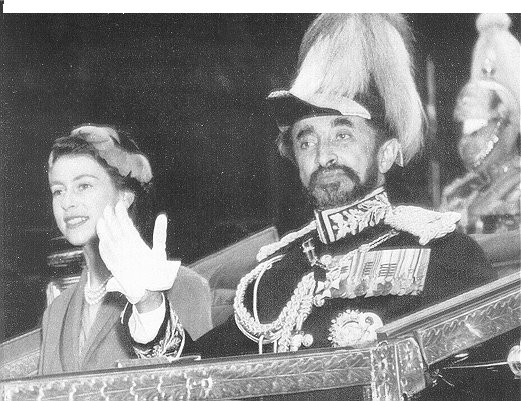
(image: HM Queen Elizabeth II & HIM Haile Selassie I, 1954, shown riding in the back of an open carriage, the Emperor waves a white-gloved hand; licensing information here)
And even when for all the right reasons, if undertaking a principle of internationalism for the good of a nation only to find certain groups within it not in favour of the unification that will see aspects of their cultural identity eroded, the options for the implementer that aren’t forceful or somehow coercive are not a lot if anything at all.
Still, given that lack of choice, nothing I’ve read or heard implements Selassie directly; the worst accusation perhaps being that while aware of some misdeeds taking place, he chose to ignore them. For what is certainly true, a policy of internationalism introduced into an environment of long-standing regional/culture grievances will provide plenty of opportunities for those in positions of power with an axe to grind, regardless of how well intended the official line.
Header image courtesy NotFromUtrecht.
More Links:
-
Blue plaques for Emperor Haile Selassie unveiled in Somerset (Ethiopian Embassy UK)
-
When the Emperor revered as the Messiah queued to get into Weston’s Tropicana (Bristol Live)
-
Blue plaque unveiled at Tropicana for Emperor exiled during World War Two (Weston Mercury)
And a special mention for the next one thanks to the following quote which perpetuates exactly the sort of thing I talk about in this series:
‘It was rumoured he loved Weston-super-Mare so much he was contemplating buying a house there.’
- The Somerset places that were home from home for Emperor Haile Selassie (Somerset Live)
Legends of Weston:
- Welcome to Weston: A Hitchhiker’s Guide to Quicksand and Curses
- Okay, so maybe Jesus didn’t visit the seaside at Weston-super-Mare, but what about any other spiritual leaders?
Coming soon:
- Dwight Eisenhower visits Weston Woods to talk with the ghost of Julius Caesar.
Thanks for reading 🙂
N. P. Ryan
To receive notifications of future posts of poetry—be they happy, sarcastic or sad—music history and reviews, the odd bit of this and that plus the occasional stab at promoting my books, please enter an email address below.
 N. P. Ryan
