A BBC news article (link below) caught my eye the other day for being on the subject of bedbugs; one of the worst types of pests one could suffer an infestation of, second perhaps only to scabies (based on all those that we were trained to treat for).
An unusual article, in that when reporting on an outbreak of bedbugs in Paris, it was uncertain on certain details, questioning whether reports of them biting people on the Metro system were true or just internet scaremongering; an uncertainty that perhaps stems from the extremely out of date notion bedbugs aren’t really a problem anymore.
The next day, when watching France 24 in the morning—something I always do, not just when there might be bedbugs—there was no doubt about what the BBC article alluded to given the footage showing them on public transport. It was also reported that the French Secretary for Transport was getting directly involved; which is a long way from the time I encountered someone on Toronto public transport running alive with bedbugs and the streetcar was allowed to carry on anyway (more below).
When training to be a pest control technician in the 90s there was a massive manual to be read covering every single pest insect, rodent and bird, what they did, how they did it, their breeding cycles, where they liked to hang out; not to mention sections on the insecticides, rodentacides and methods used to combat them, and perhaps more importantly how not to use them and what to do in the event of accidental poisoning.
It was comprehensive, even covering the likes of Anthrenus verbasci, a textile pest more commonly known as the varied carpet beetle with the power in the right conditions to do untold damage to natural fabrics, and that at least one example of can likely be found in every house in the country while never being noticed by the untrained eye.
Only one section of the entire manual was described by trainers as ‘you’ll need to know it for the tests, but it will never come up in the field’. And that was the part on bedbugs.
Header image: an 1860s plate showing the parts of a bedbug (licensing).

My first permanent patch covered Chelsea and Fulham. The patch to my east contained Earl’s Court, where there were numerous backpackers’ hostels and hotels, including the likes of the Overseas Visitors Club.
It was from this area that the first report of bedbugs came from. Though initially, so unheard of at that point in time, they were reported to us as fleas due to the bites (they being the indication of a problem).
It didn’t take long to realise this wasn’t the case when a couple were spotted by the technician doing the job; though even he couldn’t believe his eyes. Apart from anything else, part of the training for bed bugs, that apparently was never going to be needed, said don’t be surprised if never finding any during treatment due to their elusive nature.
More and more calls relating to bed bugs started to roll in from the Earl’s Court area; nowhere else in the country was receiving any. Such was the volume it wasn’t long before I—being on an adjacent patch—was being called in to help.
Then things took a turn for the worse when the complaints came flooding in.
Apparently we didn’t know what we were doing, as nothing we’d done had stopped the problem. That sort of accusation isn’t uncommon in pest control: like the time I conducted a night treatment in a pub, only for it to call the office the next day to accuse the company—well, me—of planting dead cockroaches everywhere to make the problem look worse and more treatments needed.
Before calling in pest control, the pub had only seen a couple, but that was enough to pick up the phone. To their mind, they were nipping things in the bud; but it’s an almost guaranteed rule of pest law that where is one roach, there are hundreds more, especially if seeing it/them at a time of normal human activity.
But in the case of the bedbugs it was due to hardly any dead bugs and people still being bitten.
The tech who did Earl’s Court was driven almost insane, using what was considered the best prep for the job and being super thorough each time, he still managed to arrive home one night and step out of his van only to spot a live one on his overall leg.
Reaching a crisis point of doing nothing but treat for bedbugs all day long, he even started having nightmares about them.
Plus the complaints carried on.
Convinced everything was being done that could be, the branch manager called the research and development department to tell them that not only had bedbugs made a comeback, nothing was taking them fully out. Where treatments of the types we applied should have killed every bug except for maybe the odd lucky few—hence the need for a follow up treatment or two—the reality was a good proportion seeming immune regardless of what was done.
The R&D department was known for its reluctance to come into the field—which explained many of the haphazard devices hoisted on techs that clearly had no relationship with pest control in the real world—and it apparently had to be stressed to them that things were completely out of control.
The eventual agreement to take a look came with a warning rooted in what to us working the area was already the past: fine, we’ll bring everything we’ve got [which apparently was forty-ish variations of different preps] but we’ll be lucky to find four bedbugs to test on after a day of searching!
They got their forty on the first mattress looked on at the hotel mentioned above as unforgettable. They also found that no one prep was wholly successful. Even the ones that had seemingly wiped them out in the first place only to be subsequently removed from market due to the detriment to humans had lost all conquering power.
Some things to know about bedbugs:
- They are parasites that only feed on blood
- Bedbugs are not dust mites
- They prefer to only come out at night
- There is more than one type
- They come in two ‘colours’: red and see-through
- The red is ingested blood
- The bites can be very uncomfortable, but the most detriment to humans comes in the form of impact to mental health; something that should never be underestimated in any pest scenario, especially this one.
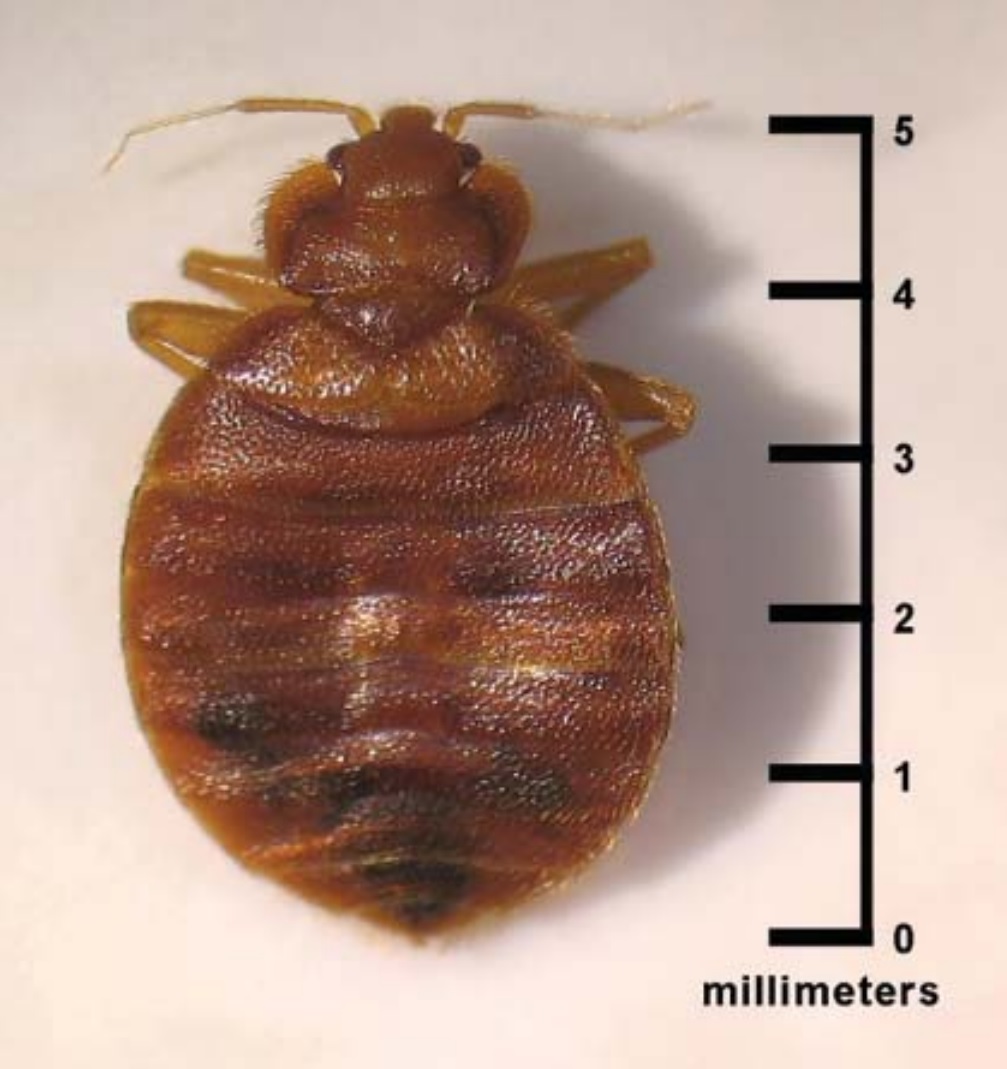
- When adult the are about half the size of a small fingernail
- Their sometimes being clear can leave them looking like flakes of skin, especially when younger and smaller.
Image: English: Adult common bedbug (Cimex lectularius) courtesy United States Department of Health and Human Services (licensing):
From hostels and cheaper digs the problem exploded. Into higher-class hotels, into private houses; I was even sent to treat a doctor’s flat in Clapham, who’d returned from a holiday only to discover them in his home. The good doctor, being an expert in people and not bugs, was just as green as any other member of the public, thinking they’d somehow got into the home due to its having been unoccupied for a couple of weeks; as though a failure to dust everyday had them rise like little parasite phoenixes from the ashes.
Travelling was always the constant in the ongoing rise in infestations and he was very pleased to hear that when compared to his own version of events. But the hows and whys, as far as I know, remain a mystery.
Bedbugs are mighty unpleasant and impossible to ignore (whereas some people don’t react to and therefore don’t feel flea bites), doctors and likewise professionals didn’t for the most part put up with them, while travelling on the cheap backpackers united in complaint. The rise of the bedbugs had a distinct pattern, starting with those on the lowest budget, moving onto more expensive hotels, and from there hitting professionals in first class on their way home.
Questions were baffling:
Where in the process exactly was the problem occurring? All the evidence pointed to luggage; people reporting there having been no problems at the other end. Was it the planes where apparently no bugs were reported biting passengers, so therefore how did an infestation of bedbugs replenish itself in a hold; or what about the luggage halls where bags are hardy still long enough for bedbugs to be crawling out the crevices with the realisation slipping into one will soon see them somewhere with a reliable food source?
The situation wasn’t helped by a couple of things.
The aspect of picking them up while in transit meant many travellers assumed it was the hotel room they’d arrived at that the bugs were already in. This would result in their asking to move rooms, which would mean their luggage went with them. Encountering them in the next room would often result in heading off for a new hotel . . .
Plus various hotel managements, while understating the concept of the bugs moving to adjacent rooms and therefore the need to treat them too, didn’t like the number of rooms and thus cost involved when including directions as simple as up and down, never mind as far out as diagonal.
The company implemented a policy of rotating the preps used given the success of each was varied; though we had no idea if some were immune to everything, or if it varied between individual bugs.
I even ended up treating bedbugs on a US news channel when it sent a crew to film technicians at work as part of a profile piece it was doing on the company. I can’t remember the name of the channel for sure—CBS, I think—but do recall it was a massive backpacking hostel on Brixton Hill where five of us had been sent in at once.
A few weeks later I was asked to go back alone to just treat a couple of the rooms; something that resulted in a backpacker winding up in hospital for the night unable to breathe having ignored the strict instructions not to enter the rooms for a set amount of time after; that was the power of the oil based insecticides we could use, but the bedbugs were still beating it.
When I left pest control, bedbugs were still causing problems; nothing found that could knock them down outright. To put that into context, the reason any treatment against cockroaches is unlikely to be successful off the bat is the simple reason it won’t reach every cockroach there while active, such as those yet to hatch. If it could, then that would be the problem gone in one go. No pest but bedbugs survived treatments due to some being resistant.
I didn’t encounter bedbugs again until living in Canada, and then two unsavoury things happened in quick succession while a friend from the UK was visiting in 2012.
The first was when a Canadian friend had visited a thrift store and then travelled home on a TTC (Toronto Transit Commission) streetcar only to feel a bite when sitting at home just after getting in; they instinctively brushed off whatever it was, only for whatever it was not to be found.
To be fair, I’ve been bitten by an ant in North America and it flipping hurt (they’re a lot bigger there), but I offered to go round and do a treatment using what could be bought at Home Depot—quite a lot if you know how to use it—despite the resistance that had been found to the particular active ingredients elsewhere; and so my mate, on the way to see the Marlies—the cheap version of the Toronto Maple Leafs—got to witness a treatment for a suspected bedbug into the bargain.
The Canadian friend never had another problem, but the fun was only just starting for me and the mate from the UK as we travelled by streetcar to see—by coincidence also from the UK—thrash legends Obituary on their first North American tour (at the Annex Wreckroom).
My mate was sat by the window to take in the sights, looking to my left to talk to him, I couldn’t help notice the bloke on the seat behind couldn’t stop scratching. He was incessant and reminded of someone I’d know years ago who’d suffered with terrible eczema. He was also clearly what might best be termed destitute; his hair long and tangled, his clothes dirty, shabby, and his shirt halfway undone.
I caught something dark red shoot across his chest; the memory still sends me into a sickly, prickly chill today. Despite all that experience in pest control, despite the explosive resurgence I witnessed firsthand take place that no one thought was possible, I never ever thought I’d see a person running alive with bedbugs. I couldn’t believe it and initially didn’t, carefully trying to catch another glimpse; yet despite trying not to look directly or obviously, I’d quickly seen enough to know it was indeed bedbugs.
I whispered in no uncertain terms to my mate that we were getting up but not getting off. At the doors I filled him in and we looked each other over, I even went and warned a couple who’d taken our seats and did so discretely enough the guy didn’t hear.
With the front of the streetcar full of standing riders and our stop only a couple away, I waited to get off, then boarded the front of the streetcar to tell the driver. He listened to everything I said, and then the streetcar continued on its way.
The following day, I contacted the TTC to ensure they knew the report was legitimate. They told me the driver had made an error in not evacuating the streetcar immediately and they made a very valid point, except . . . remember that bit earlier about theory and practice?
For a start, I had nothing to identify me as knowing the first thing about pest control. Who was I for the driver to take my word? Even if the driver went to look, was he qualified to know what for? What was he meant to do anyway: evacuate the streetcar just so everyone, person with bedbugs included, could get on the one right behind, causing a coming together of people in the process of getting on that would also see more people in total onboard that one?
Who was going to step in and stop the carrier getting on, under what rule or law, and what were they—a human being—meant to do regarding the rest of the journey they’d been on?
Even though I’d watched in horror as that streetcar pulled away, bedbugs and innocent unknowing passengers still onboard, feeling that I should’ve done something more, I also realised the impossibility of the situation; something that those at the TTC office clearly hadn’t thought much about at all.
Far more relevant was the announcement somewhere around the time—after, I think—that the City of Toronto was no longer providing free bedbug treatments for people who weren’t financially able to afford them. I tried to find out exactly when by searching ‘toronto city hall announce no more free bedbug’ but so many results came up from different years about bedbugs in general I soon gave up.
Though one was interesting in that, dated 2010, it was about the Toronto International Film Festival announcing it would be bug free after a reported spate of infestations in New York City cinemas, yet the BBC article treats the idea of bedbugs in French cinemas with scepticism, as though still in that long-ago mindset.
Though what the article, and also the one of France 24, did mention is what’s really the only important aspect: the link between the increase in bedbugs, poverty and an ever increasing failure of society to help those in need (the general populaces’ democratic favouring of certain types of policies very much destined to bite them on the bum).
The return of bedbugs to major Western cities started in the 90s and never went away; thus on one hand it could be said this is now a common story being presented in a sensational way that leaves it looking a problem solely of Paris; while on the other, there’s no doubting the footage from Paris shows something very much in the extreme.
The thing is, if it can happen somewhere, it can happen anywhere.
Night, night; sleep tight x
(today there are new treatments to combat bedbugs that rely not on insecticides but temperature and to my understanding are successful; though of course, they’re completely useless to people who can’t afford them.)
Update 10/10/23: in the few days since this was posted a number of developments have taken place. The BBC continued its somewhat bizarre coverage the following day with an article headlined ‘Are there Bedbugs in the UK?’ like there might possibly not be when as said above serious infestations have been back in the country for three decades, or to be even more dramatic, since the last millennium.
The day after that an article appeared (link below) where a chap from Sheffield told the story of getting bedbugs from secondhand furniture two years ago and not having been able to get rid of them since despite spending a lot of time and money trying to.
Above this update I finished by saying that new treatments involving heat are apparently successful where insecticides aren’t. The nature of the treatments isn’t gone into in the article beyond:
‘ “I’ve got an exterminator coming in tomorrow to do another set of sprays,” he told the BBC on Friday. ’
One thing the general public has an aptitude for is assuming it knows what’s going on when actually it hasn’t got the first clue. It’s interesting that the term ‘sprays’ is used, as almost without fail people would call spray treatments ‘fumigating’ when fumigation is an entirely different ball game to spraying.
It’s not possible to take the term at face value, which leaves two possibilities:
- It is indeed spray treatments, which would rely on the preps that were found not to work all those years ago, which in turn begs the question why are they still be applied in the face of the new and more successful above mentioned heat treatments?
- It is in fact the above mentioned heat treatments and they’re no longer wholly successful.
It’s in this respect the BBC’s reporting is bizarre: what are important questions are treated like not even being realised, while in many of its articles now appearing on the subject someone always seems to be found who plays down the threat to people, in some cases even ignoring the impact to mental health.
There’s absolutely no doubt in my mind that these so-called experts have never suffered a bedbug infestation. Bedbugs are vile. In situations witnessed by myself a person can end up running alive with them, constantly bitten. I dealt with enough victims of them in situations nowhere near that bad to know the distress they cause. Even with that aspect aside, there’s still the cost involved and the apparent possibility it won’t ever solve the problem.
To be fair to the Beeb, it seems they’re not the only ones grossly missing numerous points; a report (link below) on the possibility of the problem spreading to London transport quoted mayor Sadiq Khan saying ‘Transport for London was disinfecting seats daily.’
Oh, so that’s where the worldwide pest control industry has been going wrong since the 90s: not using disinfectant . . .
If these treatments are especially for bedbugs then a lot of taxpayer money is being wasted just for a placebo effect; while if it’s a case of the wrong terminology being used, then that’s a whole other kettle, for if it is instead insecticide—for a spray is certainly suggested in the quote—one has to wonder how enough time is found between the treatment and vehicle returning to service for it to be safe for humans again.
In fact, it would be logistically impossible to keep the system running and is perhaps why it is very clearly heat treatments shown used on the Paris Metro.
Links:
- Original BBC article
- France 24 ‘French government launches battle plan against bedbug invasion’
- BBC: ‘I’ve suffered from bedbugs for two years’
- BBC: Bedbugs: Sadiq Khan reassures Londoners over France problems
Thanks for reading 🙂
N. P. Ryan
To receive notifications of future posts of poetry—be they happy, sarcastic or sad—music history and reviews, the odd bit of this and that plus the occasional stab at promoting my books, please enter an email address below.
 N. P. Ryan